Geriatric assessments
Beyond the dependency assessment, which follows the scale of each country, Resthome brings together the main geriatric scales used in the nursing home to objectively measure cognition, pressure ulcer risk, nutritional status, oral health and fall risk. You will find them in two places:
on the resident’s record, the « Evaluation Tools » tab, where each scale shows the resident’s history and allows direct entry;
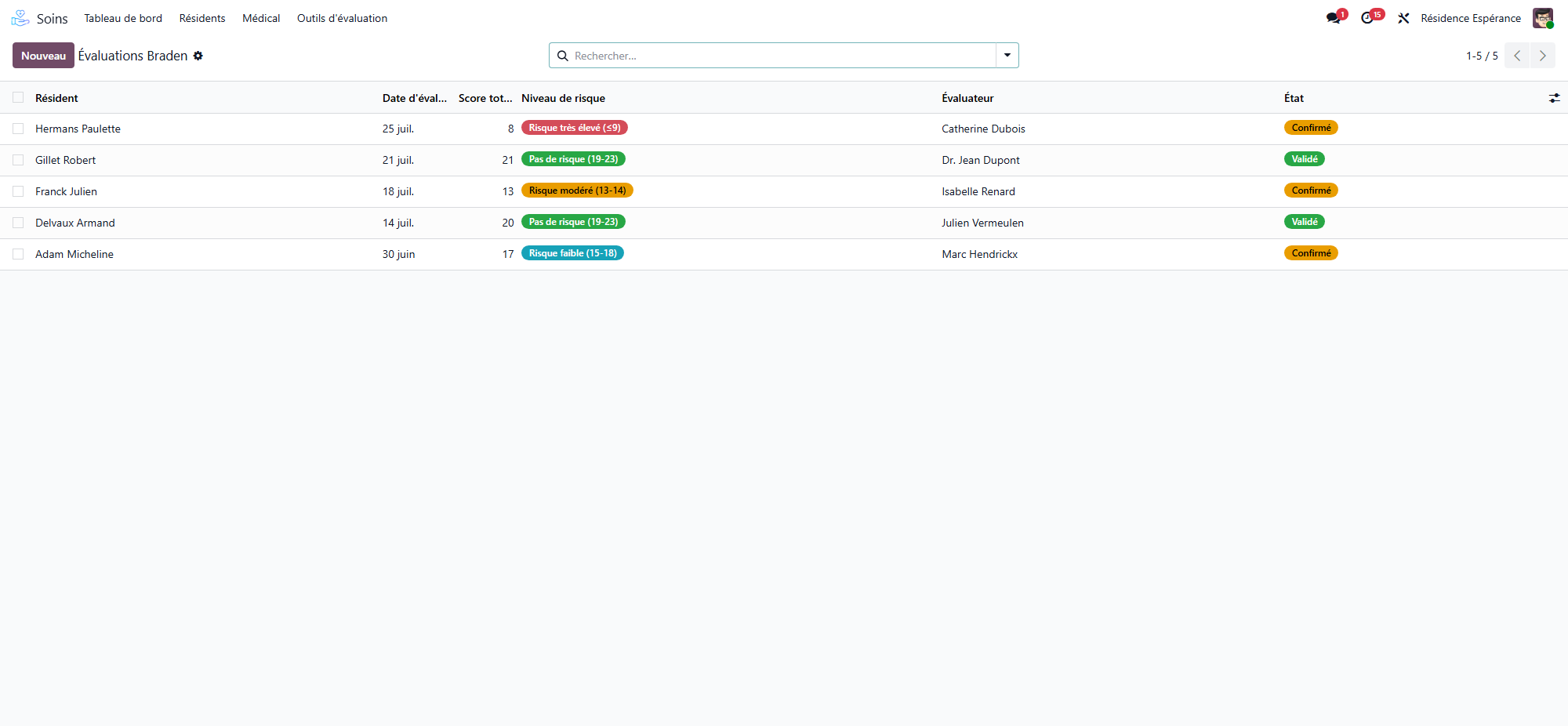
via the Healthcare > Evaluation Tools menu, which lists all the assessments in the facility, scale by scale.
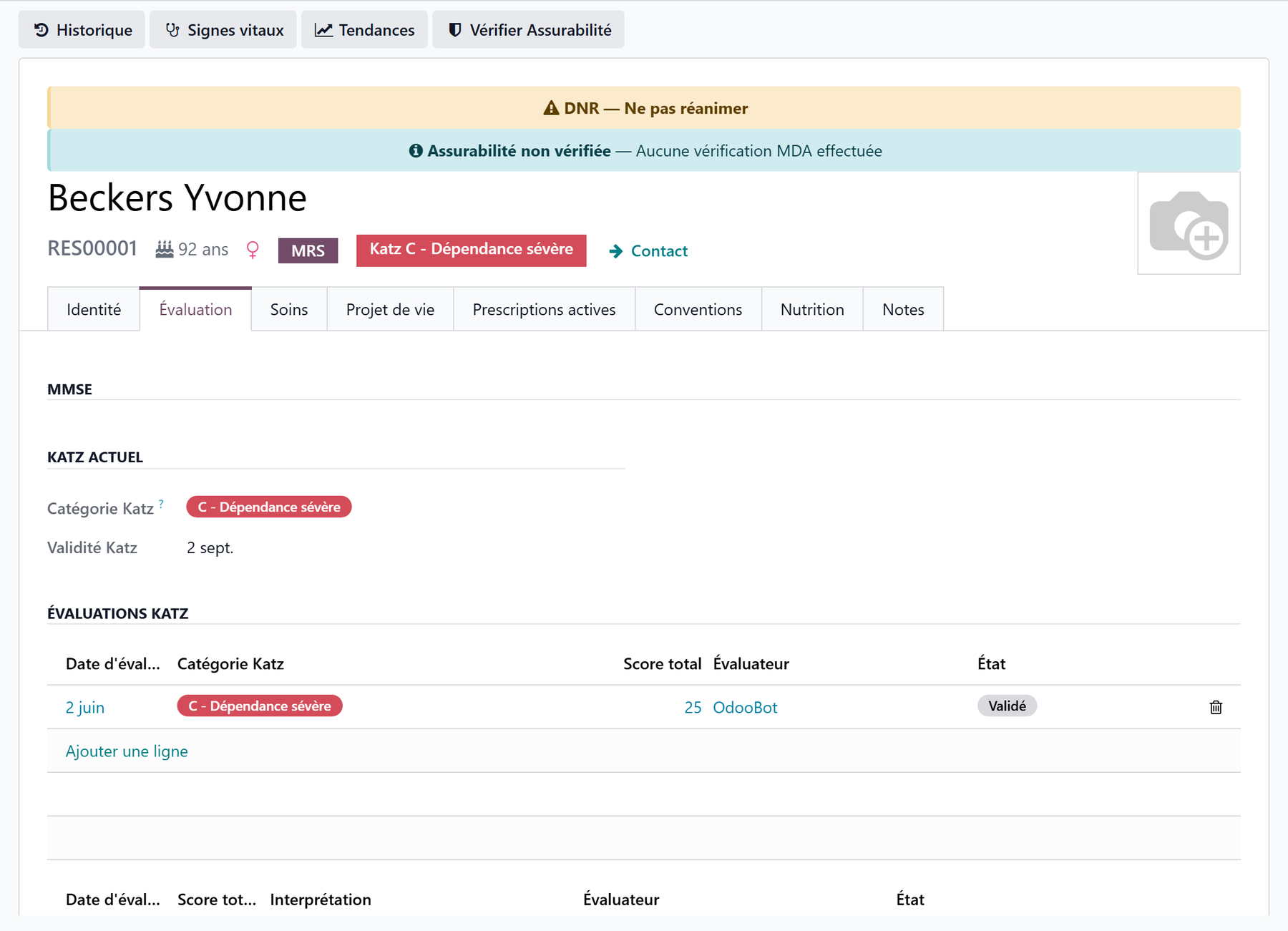
Available scales
Scale |
What it measures |
Score |
Meaning |
|---|---|---|---|
MMSE |
Cognitive function |
/30 |
Higher = better |
Braden |
Pressure ulcer risk |
/23 |
Lower = more at risk |
MNA |
Nutritional status |
/14 |
Lower = more at risk |
OHAT |
Oral health |
/16 |
Higher = more at risk |
Tinetti |
Balance and gait (falls) |
/28 |
Lower = more at risk |
The dependency category stays separate
The dependency scale determines the dependency category, on which the care allowance paid by the health insurer relies; it follows the country’s rules and its own renewal cycle. The five scales below are international and do not change that category.
In Belgium
The dependency scale is Katz, with its categories, its renewal due date and its reminders — see The Katz assessment.
MMSE — cognitive function
The MMSE (Mini Mental State Examination) is a standard cognitive screening test out of 30 points. You tick each successful item, spread across 7 domains:
Domain |
Points |
|---|---|
Orientation in time |
5 |
Orientation in space |
5 |
Registration (3 words) |
3 |
Attention and calculation |
5 |
Recall (3 words) |
3 |
Language |
8 |
Visuo-constructive praxis |
1 |
Resthome adds up the ticked items and displays the interpretation:
Score |
Interpretation |
|---|---|
27-30 |
Normal |
21-26 |
Mild cognitive impairment |
11-20 |
Moderate cognitive impairment |
0-10 |
Severe cognitive impairment |
Braden — pressure ulcer risk
The Braden scale predicts pressure ulcer risk. You score 6 subscales (radio buttons):
Sensory perception (1-4)
Skin moisture (1-4)
Activity (1-4)
Mobility (1-4)
Nutrition (1-4)
Friction and shear (1-3)
The total ranges from 6 to 23. Warning: the lower the score, the higher the risk.
Score |
Risk level |
|---|---|
19-23 |
No risk |
15-18 |
Mild risk |
13-14 |
Moderate risk |
10-12 |
High risk |
9 or less |
Very high risk |
MNA — nutritional status
The MNA (Mini Nutritional Assessment, short form) screens for malnutrition risk out of 14 points, from 6 questions:
Reduced food intake over the past 3 months (0-2)
Recent weight loss (0-3)
Mobility (0-2)
Acute illness / psychological stress (0 or 2)
Neuropsychological problems (0-2)
Body mass index — BMI (0-3)
Score |
Nutritional status |
|---|---|
12-14 |
Normal |
8-11 |
At risk of malnutrition |
0-7 |
Malnourished |
Nutritional follow-up
Malnutrition follow-up (MNA re-scoring reminders, intake vs needs, hydration) relies on the clinical registers and the care module. See The clinical registers.
OHAT — oral health
The OHAT (Oral Health Assessment Tool) assesses oral health across 8 categories, scored from 0 (healthy) to 2 (needs treatment): lips, tongue, gums and tissues, saliva, natural teeth, dentures, oral cleanliness and dental pain.
The total ranges from 0 to 16. Here, the higher the score, the more concerning the situation.
Score |
Oral health status |
|---|---|
0-3 |
Healthy |
4-8 |
Changes needed (refer to a dental professional) |
9-16 |
Unhealthy (urgent referral) |
« N/A » options
The Natural teeth and Dentures categories have an N/A (not applicable) option: it is excluded from the total score calculation.
Tinetti — balance, gait and fall risk
The Tinetti scale (POMA) assesses balance and gait to estimate fall risk:
Balance section: 9 items, /16
Gait section: /12
Total: /28
Resthome calculates the two subscores and the total.
Score |
Fall risk |
|---|---|
25-28 |
Low risk |
19-24 |
Moderate risk |
Under 19 |
High risk |
Tinetti, Morse and the falls register
The « Evaluation Tools » tab offers Tinetti. For the Morse scale and the falls register (incidents, preventive measures, reassessments), use the clinical registers.
Entering and validating an assessment
All scales follow the same flow:
Open the scale: from the resident’s « Evaluation Tools » tab, or via Healthcare > Evaluation Tools.
New: the resident, the date (today by default) and the assessor (you) are pre-filled. Score the items.
Confirm: the assessment moves from Draft to Confirmed.
Validate: the head nurse or the physician validates; the assessment moves to Validated, with the validator and the validation date recorded.
The status bar follows these steps: Draft → Confirmed → Validated (plus Cancelled). The available buttons are Confirm, Validate, Cancel and Reset to draft.
Locking and retention
A validated assessment is locked: its scores can no longer be edited. To correct it, click Reset to draft (restricted to the head nurse). Validated assessments cannot be deleted: health data must be retained (GDPR and the country’s health-data retention rules).
One assessment per day
There can only be one assessment per resident, per date and per scale. The date cannot be in the future, and no assessment can be created for a deceased resident.
Follow-up and reassessment
The « Evaluation Tools » tab keeps the dated history of each scale: to reassess, enter a new assessment on a new date.
The dependency scale has its own renewal cycle (validity due date, reminders), set by the country pack.
For a structured periodic reassessment cycle (calculated due date, keep / change / stop decision, follow-up log), use the clinical registers.
Key points to remember
Five international scales: MMSE, Braden, MNA, OHAT and Tinetti, on the resident’s « Evaluation Tools » tab.
Score meaning: MMSE and Tinetti, a high score = favorable situation; Braden and MNA, a low score = more at risk; OHAT, a high score = more at risk.
Common flow: Draft → Confirmed → Validated; validation is restricted to the head nurse or the physician.
Validated = locked and retained; reset to draft to correct.
One assessment per resident, per date and per scale.
Learn more
The clinical registers — falls (Morse), restraint, pain, wounds, periodic reassessments.