The candidate’s file
The Resident Admission tab is where the candidate’s file is built, without leaving the enquiry.
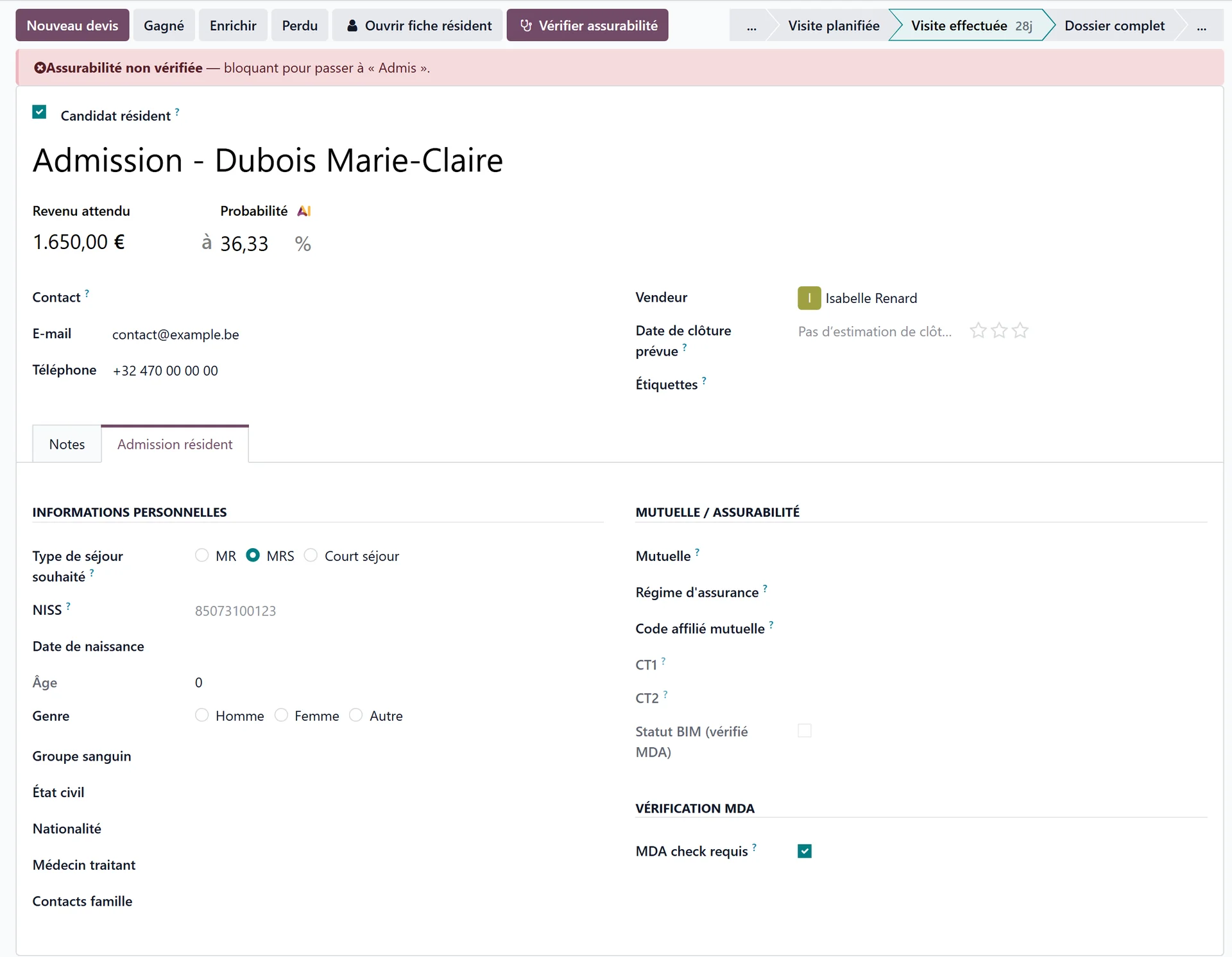
Personal information
Desired stay type — MR, MRS or day care, offered according to the facility’s approvals. It is not required to fill in the file, but it is required to admit: it determines the bed and Annexe 7.
Short stay — derived from the stay type. It then asks for the number of short-stay days used this calendar year and for notes.
Identity: NISS, ID card and expiry, date of birth, age, gender, blood type, marital status, nationality, place of birth.
Resident language and spoken languages, religion.
Attending physician and deputy physician.
Family contacts, telephone, e-mail.
No approval on file
If the facility has no approval recorded, no stay type can be offered. The banner This establishment has no approval on file yet appears, with a Record the approvals link — fill them in first.
Short stay: 90 days a year
The law caps short stays at 90 days per calendar year. Enter the days already used — ask the family, or confirm with the health insurer — before accepting the admission.
Health insurer and insurability
Mutuelle, insurance regime, membership code, CT1, CT2, BIM status.
MDA Check: MDA check required, latest MDA, MDA status, Insured, last check.
The Check insurability button sends an MDA request and fills in the health insurer, the BIM status and the CT1/CT2 codes on its own. It needs the NISS: without it, Resthome asks for it first.
The insurability check gates the admission
As long as the check has not succeeded, moving to Admitted is refused. For a case that does not require it — a candidate with no NISS, for example — untick MDA check required.
If the answer comes back not insured, the admission is still possible: an orange banner warns that billing will have to be addressed to the resident, and the answer is recorded in the file’s history.
Key contacts
Three roles, each with a box to tick when the person does not exist:
Emergency contact — or No emergency contact
Legal representative — or No legal representative
Trusted person — or No trusted person
The box matters: it tells the team that the question was asked, rather than leaving an empty field that looks like an oversight.